

Inferred schema
Dataerai infers each column’s name and type — for example:- Quantitative — numeric measurements.
- Nominal — categories and labels.
- Temporal — dates and times.
- Boolean and string values.
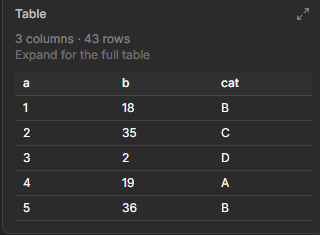
The inferred table — column names and a row preview (here, 3 columns × 43 rows).
Summary statistics
For each column, Dataerai computes a profile so you can spot issues and understand distributions at a glance, including:- Counts and how many values are missing.
- The number of distinct values.
- Ranges and quantiles for numeric columns.
- The most common values (category counts) for categorical columns.
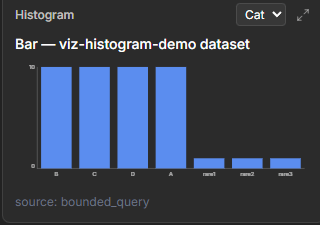
Statistics surface as charts — here, category counts for a categorical column.
Why it matters
The schema and statistics power the rest of the analysis experience: they drive the built-in charts and help you catch problems — an unexpected type, a column full of nulls, a surprising range — early.Next steps
Visualize your data
Turn these columns into histograms and category charts.